Execution Visibility For Professional Services.
Workora is an enterprise operating platform designed to give professional-service firms a clearer view of client work, ownership, deadlines, workload, time, and operational risk.
A professional-service firm may have teams working all day, calendars full, clients being served, documents moving, and invoices being produced. Yet leadership can still struggle to understand which work is truly moving, which commitments are at risk, and where intervention is required.
Workora was designed around that gap between activity and execution visibility.
Workora brings together the major operational dimensions of professional-service execution — not as separate modules, but as one connected environment.
Work is not isolated from its operational context.
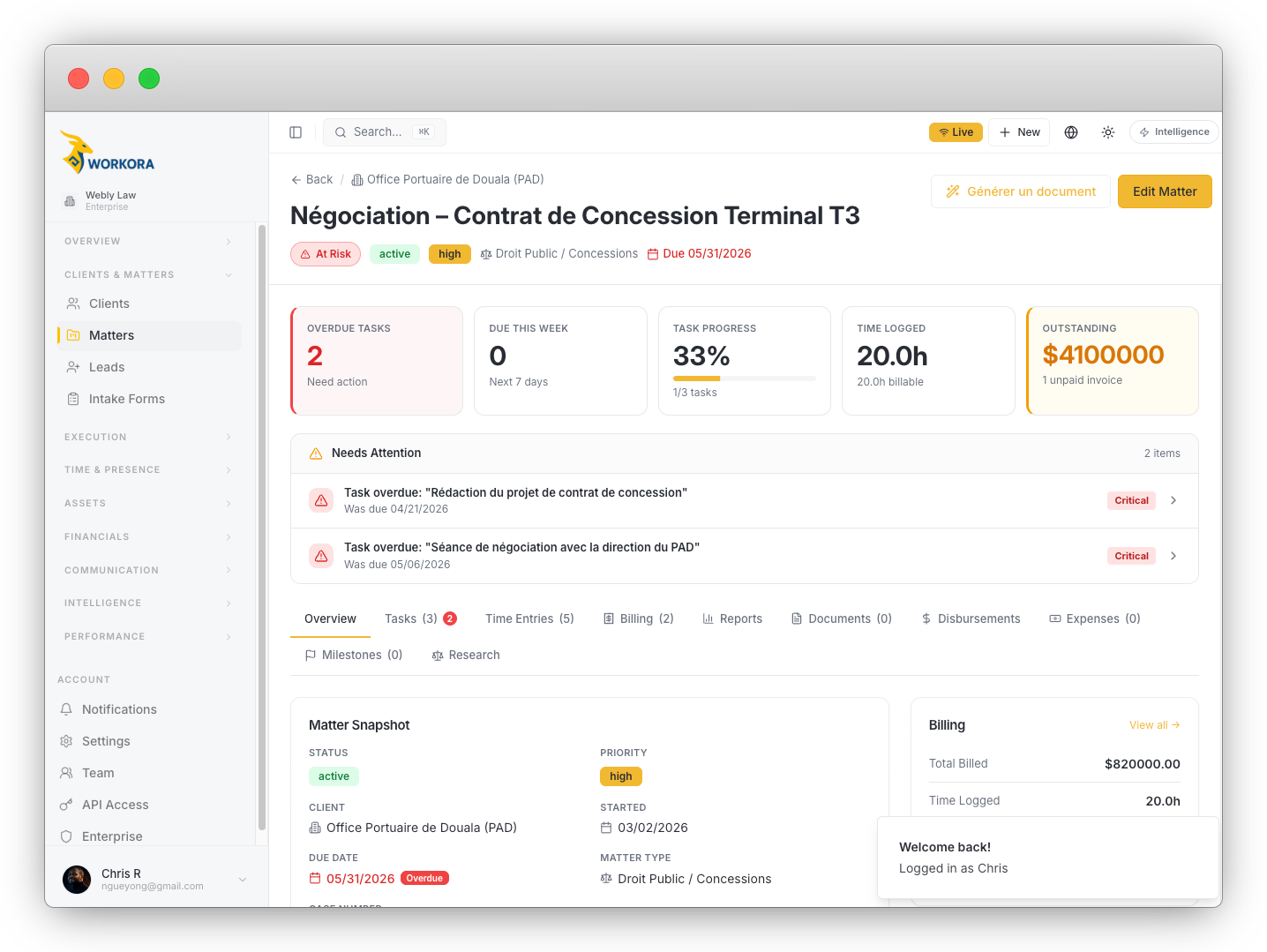
Work is organized around the real unit of client delivery — matters, engagements, or projects — rather than disconnected task lists.
Tasks, milestones, owners, priorities, and follow-ups make responsibility explicit across every engagement.
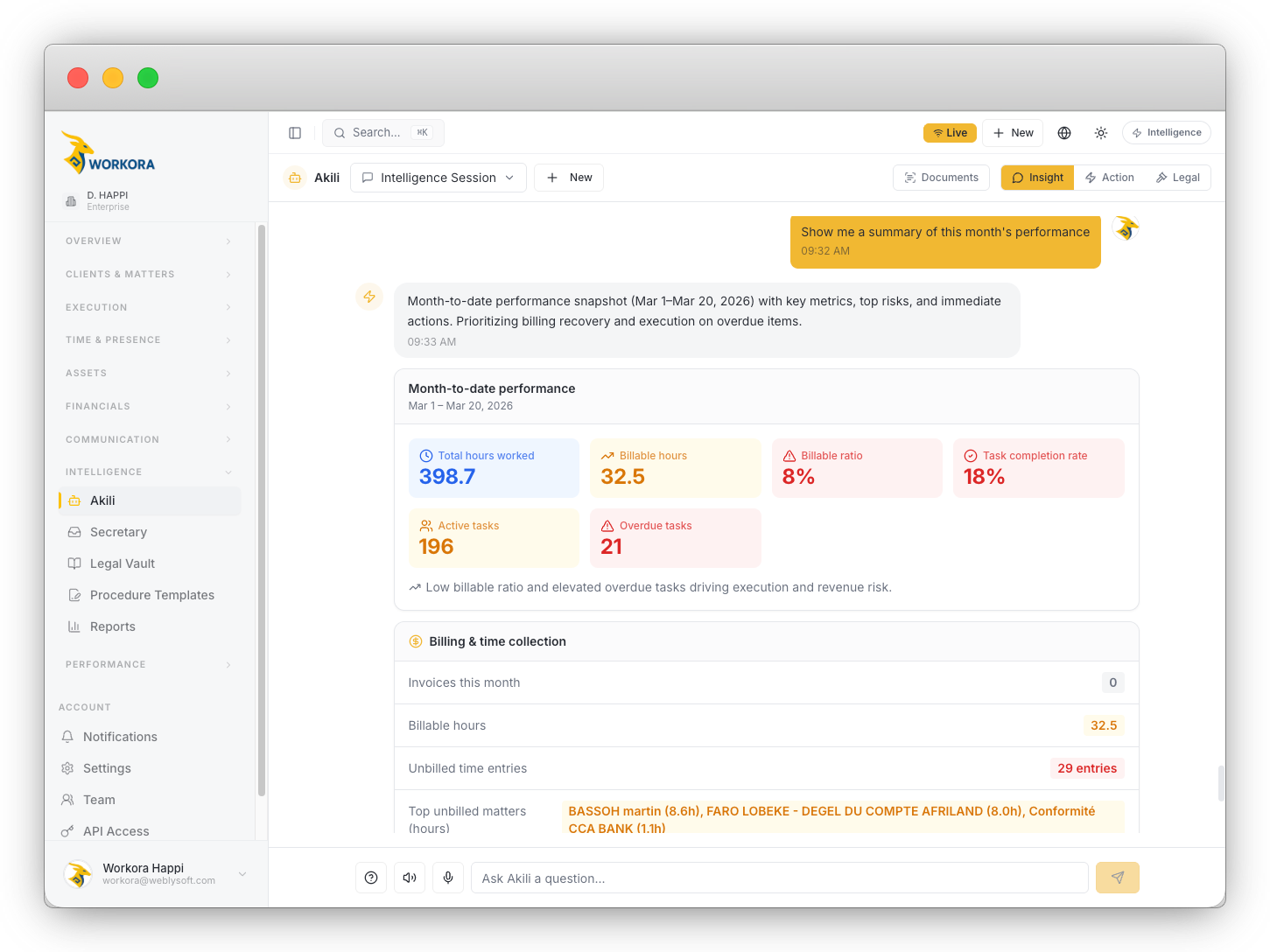
Time, activity, team capacity, and workload help managers understand not only what is being done, but whether teams can realistically deliver what comes next.
Billing, expenses, disbursements, milestones, and operational status live closer to the work they affect.
Workora is designed to surface the work that deserves attention — overdue commitments, execution risk, workload, outstanding actions, time, and financial context.
In professional services, tasks exist inside a broader client context. Deadlines affect matters. Documents affect decisions. Time affects capacity and profitability. Ownership affects client outcomes.
Workora keeps those relationships visible.
Professional-service work becomes fragile when the next action exists only in someone's inbox, notebook, or meeting notes. Workora makes ownership explicit around tasks, deadlines, milestones, and client work.
Responsibility becomes visible.
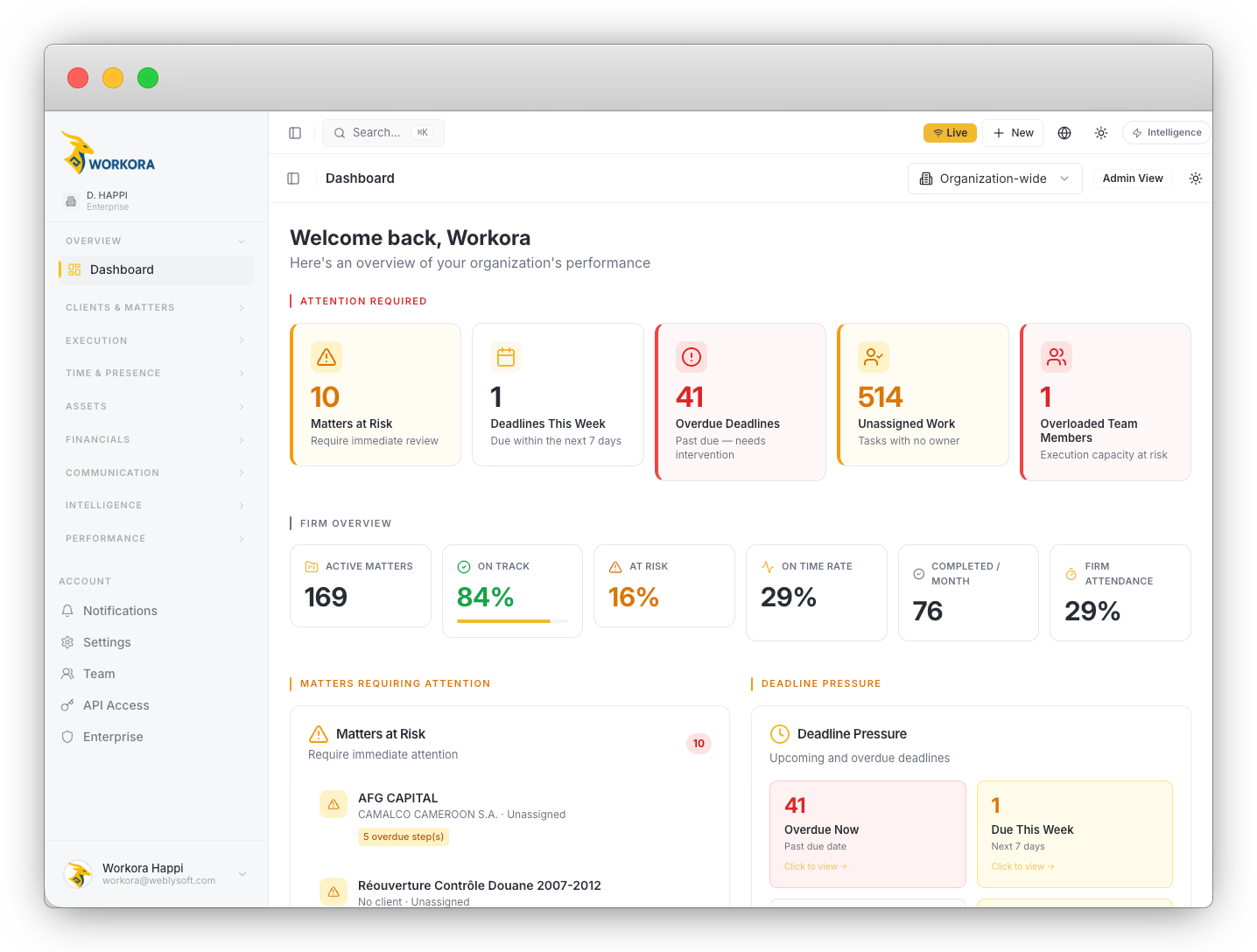
Deadlines, stalled work, overdue tasks, and changing matter status are signals. Workora is designed to make those signals easier to see before they become client-service failures.
Earlier signals. Earlier action.
Workora is not designed around surveillance or individual activity for its own sake. Its purpose is to help firms understand whether work is moving, responsibilities are clear, commitments are being met, and capacity is aligned with demand.
Matters, client obligations, deadlines, and partner oversight — all in one structured environment.
Engagements, deliverables, teams, client commitments, and execution tracking.
Client work, review cycles, deadlines, workload, and financial context in one view.
Projects, milestones, documents, team coordination, and client delivery.
Workora can adapt its operating language to the professional environment it supports.
Organizes individual actions.
Connects tasks to client work, ownership, deadlines, time, financial context, and leadership visibility.
Shows information after activity occurs.
Keeps operational signals closer to the work itself.
Forces every organization into the same abstraction.
Designed around professional-service execution.
What work is at risk?
Who owns what happens next?
Where are deadlines or commitments slipping?
Where does leadership need to intervene?
Those questions shaped the operating model more than a conventional feature checklist.
Managing-Partner Command Center — overview of matters, ownership, deadlines and operational risk.
Leadership sees where work stands across all active matters — not a filtered summary from a status meeting.
Every task, milestone, and commitment has a named owner. Responsibility does not disappear between teams.
Execution signals surface before they become client-service failures — designed to enable intervention before it is too late.
Workload, time, financial context, and operational status sit closer to the work — giving leadership a more complete picture.
Professional Services Need More Than Tools For Doing Work.
They Need A System For Seeing Execution.
Working through a similar visibility or execution problem? We can help determine what kind of system your organization actually needs.