Leadership should not wait
to understand what is happening.
Weblysoft designs operational intelligence systems that allow leaders to interact directly with their organization; in real time, with clarity, without relying on intermediaries.
Most leaders rely on reports, meetings, and updates.

The issue is not lack of data. It is lack of access.
Organizations generate information constantly. The question is whether leadership can access it directly; or whether every insight must travel through intermediaries, summaries, and interpretation layers first.
- Understanding depends on intermediaries; team leads, department heads, reports
- Summaries replace direct visibility; by definition incomplete and selective
- Interpretations filter reality; before leadership ever sees it
This creates a gap between what is happening and what leadership understands. The gap may be small; or it may be significant. Either way, it exists.
- Questions are answered immediately; by the system, not by people
- Visibility is direct; not filtered through layers of interpretation
- Understanding is continuous; not limited to scheduled reporting cycles
This is not about having more information.
It is about having direct access to it.
You may recognize this.
A leader asks for a summary; and waits. The answer comes hours or days later, filtered through the person who prepared it.
A meeting is scheduled to understand a situation; because there is no other way to get the full picture quickly enough.
Multiple reports are reviewed; each showing a part of the picture. No single source shows the whole.
Questions require coordination across teams; escalating up one layer, then down another, before an answer is returned.
Insights arrive after the moment they were needed; useful for analysis, but not for the decision that had to be made.
Risk is identified after it surfaces; because the system does not surface it proactively, and no one saw it coming.
We design operational intelligence.
Not by generating more reports; but by enabling direct interaction between leadership and the organization. Leaders ask. The system answers; immediately, with context and clarity.
Request a ReviewAsk questions about execution, decisions, and operations
Leaders interact directly with the organization; querying matters, decisions, risks, and performance without waiting for anyone to prepare an answer.
Receive immediate, structured answers
Responses are not pulled from stored reports. They reflect the current state of the organization; with context, relationships, and implications included.
Identify risks and inconsistencies early
The system surfaces what requires attention; before it escalates. Leaders see risk as it forms, not after it has already impacted delivery or compliance.
Understand the organization without intermediaries
Direct access replaces the dependency on team leads, department heads, and status updates. Understanding is always available; not on a schedule.
Five capabilities that change how leadership interacts with the organization.
Direct Organizational Query
Leaders can ask: What is currently at risk? Which matters are delayed? Where are decisions pending? What requires immediate attention?; and receive immediate, structured answers.
Real-Time Insight
Information is not delayed, aggregated later, or reconstructed manually. It is accessed as the organization operates; reflecting current state, not historical reporting.
Contextual Understanding
Answers include context, relationships, and implications; not just raw data. Leadership understands not just what is happening, but why it matters and what should happen next.
Cross-System Visibility
The intelligence layer connects execution, decisions, and financial flows across the organization. Insights are not limited to one domain; they reflect the organization as a whole.
Actionable Interaction
Leadership does not just observe. From within the intelligence system, they can trigger follow-ups, assign responsibility, and address issues directly. Understanding leads immediately to action; without coordination overhead or additional meetings.
Interacting directly with the organization.
A conversational intelligence interface where leadership can ask questions and receive structured, real-time answers about execution, decisions, risks, and performance; across the entire organization.
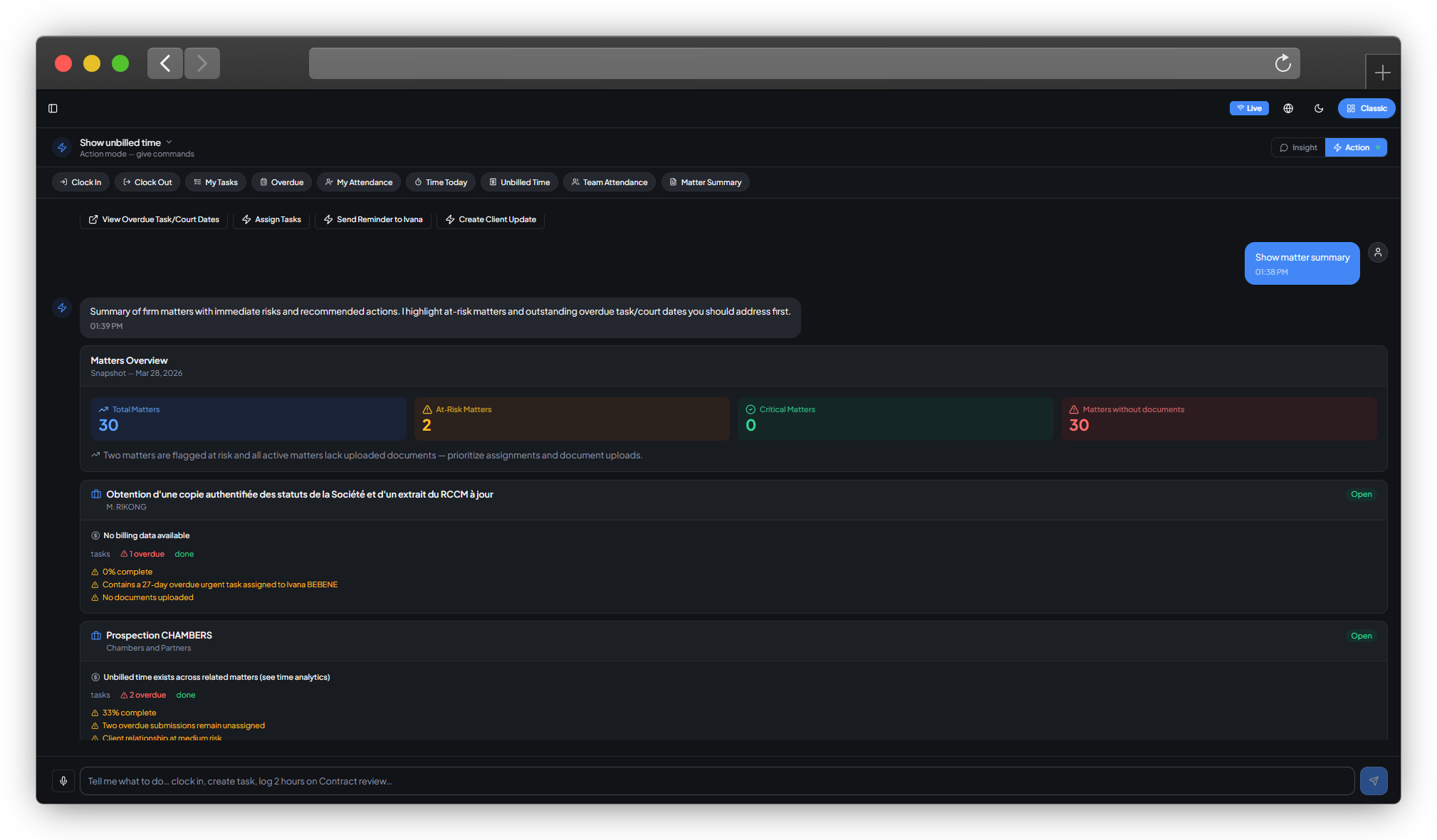
Action mode; a real-time overview of all active matters, surfacing at-risk and critical items with task completion status, recommended actions, and direct actionability from within the intelligence interface.
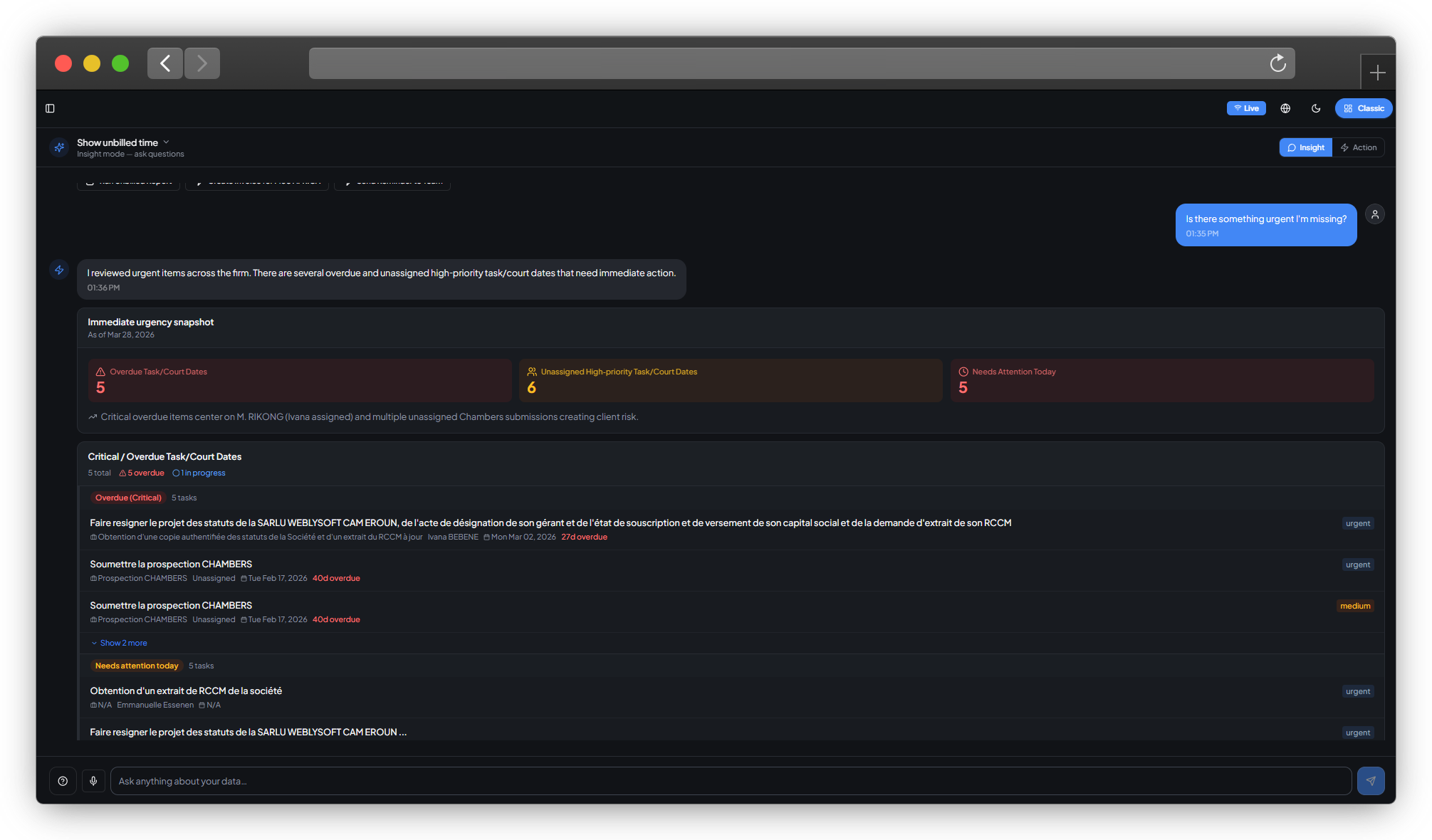
Insight mode; leadership queries the organization directly. "Is there something urgent I'm missing?" returns an immediate urgency snapshot: overdue court dates, unassigned high-priority tasks, and matters requiring attention today.
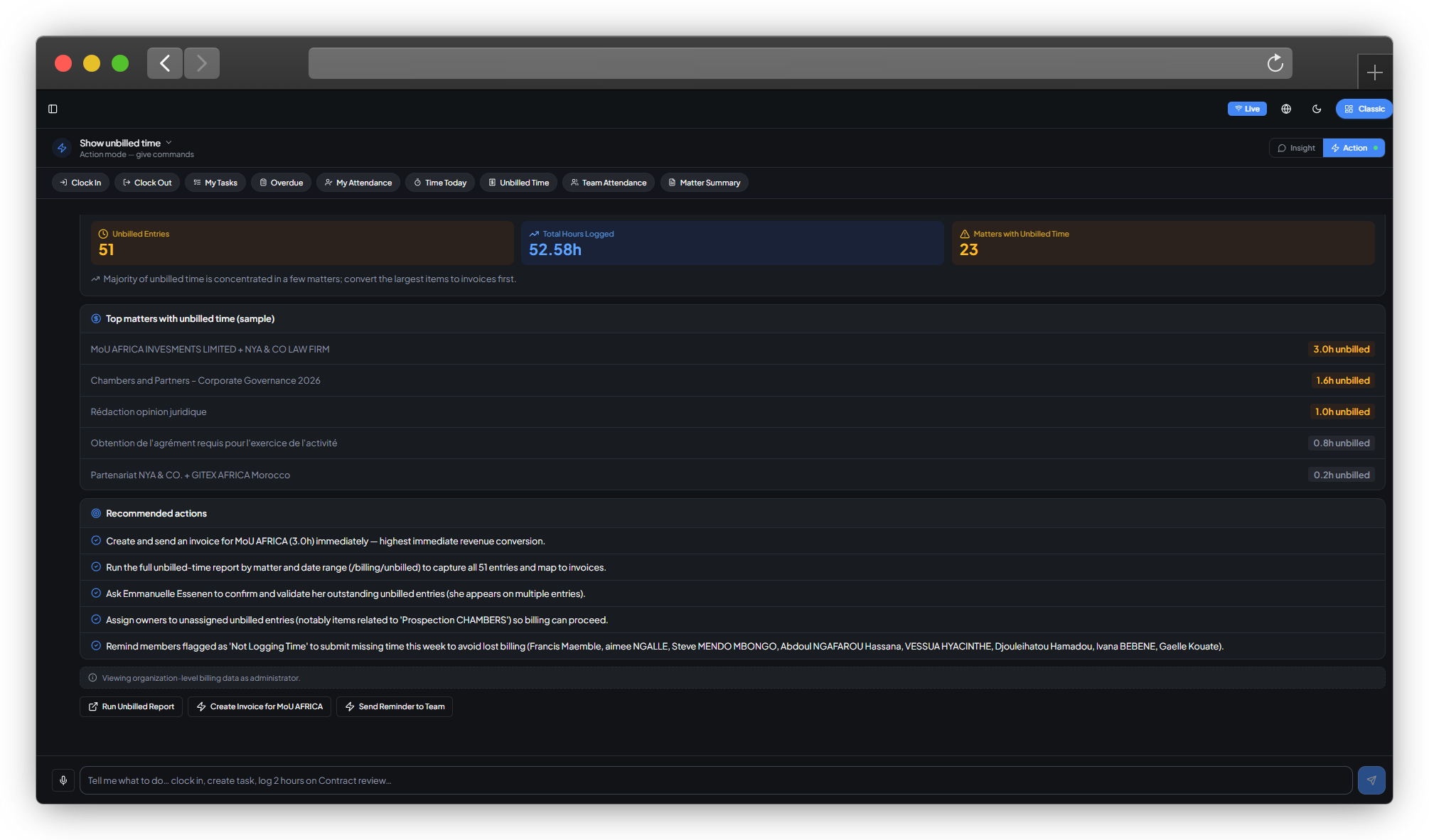
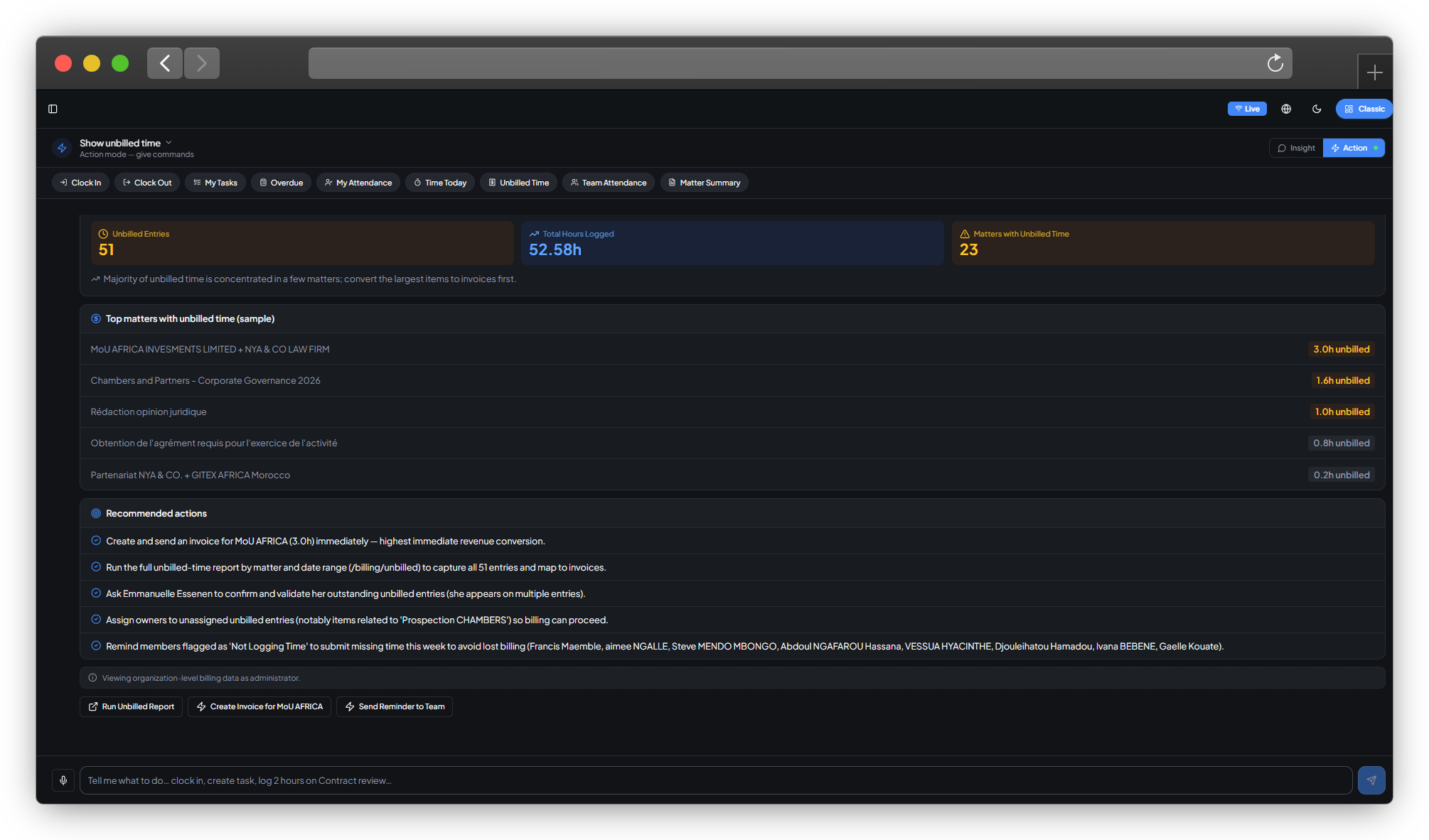
Operational intelligence applied to revenue exposure; 51 unbilled entries, 52.58h at risk, prioritized by matter, with specific recommended actions to recover billing before it is lost.
This is not a report.
It is direct access to the organization.
The structural shift; and what it means for leadership.
- Leadership relies on reports and summaries
- Understanding is delayed by intermediaries
- Information is fragmented across systems
- Decisions are reactive; made after the fact
- Clarity requires a meeting to be arranged
- Leadership interacts directly with the organization
- Understanding is immediate; on demand
- Information is connected across all domains
- Decisions are proactive; made before risk escalates
- Clarity is continuous; not event-driven
This system changes how leadership operates.
The organization moves from leadership understanding the organization through summaries and meetings; to leadership interacting with the organization directly, at any moment, with full context.
Leadership gains
- Speed in decision-making; based on current data
- Clarity across the entire organization; always
- Early awareness of risk; before it compounds
The organization gains
- Reduced dependency on status meetings
- Consistent leadership attention to what matters
- Faster response to emerging problems
An operational intelligence system.
Implemented as the interface between leadership and the organization; enabling direct, real-time interaction with execution, decisions, and financial flows across every domain.
Without intelligence, visibility is incomplete.
Without visibility, control is limited.
Every decision a leader makes is constrained by the quality of information available at the moment of that decision. When that information is delayed, filtered, or incomplete; every decision carries the cost of that gap.
If you had to understand the current state of your organization right now; would you wait for reports, schedule a meeting, and gather information manually?
Or could you see it instantly; directly, with full context, and without asking anyone?
Request a Strategic Review
We assess how leadership currently accesses and understands operational information, identify where visibility is delayed or incomplete, and outline how to enable direct intelligence.
Assessment focused on execution, structure, and control. No obligation.