Hiring decisions should
be defensible.
Weblysoft designs systems that structure how organizations evaluate, compare, and justify hiring and promotion decisions; from first review to final record.

Most organizations believe they hire carefully.

The problem is not hiring. It is how decisions are made.
Every organization hires. The question is whether the basis for those decisions is structured; or whether it depends on impressions, memory, and informal discussion.
- Two candidates are evaluated differently; by different people, with different criteria
- Criteria are applied inconsistently; what matters shifts across roles and reviewers
- Justification is reconstructed after the fact; not captured at the point of decision
This creates internal disagreement, difficulty explaining decisions, and exposure during audits or disputes.
- Evaluation is consistent; same criteria applied across every candidate
- Comparison is structured; strengths and gaps visible side by side
- Rationale is captured at every stage; not recalled or rebuilt afterward
The organization believes it is making informed decisions.
With structure, it actually is.
You may recognize this.
A shortlist is presented; but the comparison between candidates is largely subjective, not structured.
Interview feedback is collected; but not standardized. Different reviewers assess different things.
A hiring decision is made; but the reasoning is scattered across notes, emails, and informal discussion.
A promotion occurs; but the criteria for selection are not clearly defined or consistently applied.
Months later, a decision is questioned; and justification must be rebuilt from memory and partial records.
An audit or dispute arises; and the organization cannot produce a complete, structured record of the decision.
We design hiring decision intelligence.
Not by automating recruitment; but by structuring how decisions are evaluated, compared, and justified across every role and every level.
Request a ReviewDefine consistent evaluation criteria
Every candidate is assessed against the same structured framework; eliminating subjective variance across reviewers and roles.
Compare candidates in a structured way
Side-by-side comparison is built into the process; decisions are grounded in structured evidence, not impression.
Capture rationale at the point of decision
Decision basis is recorded when the decision is made; not recalled or reconstructed afterward.
Maintain a permanent, defensible record
Every hiring and promotion decision has a complete, retrievable record; ready for any internal review, audit, or dispute.
Five capabilities that structurally change how hiring decisions are made.
Structured Evaluation Framework
Candidates are assessed against clearly defined criteria; not subjective impressions or inconsistent notes. Every evaluation follows the same structure, regardless of reviewer.
Comparable Candidate Analysis
Candidates are compared using standardized metrics. Strengths and gaps become visible side by side. Decisions are no longer based on perception; they are based on structured comparison.
Decision Rationale Capture
Every decision includes evaluation data, comparison context, and final justification. Nothing is left to memory. The record exists from the moment the decision is made.
Permanent Decision Record
All hiring and promotion decisions are stored in a structured, retrievable format; creating auditability, institutional memory, and defensibility over time.
Internal Mobility & Promotion Governance
The same framework applies to promotions and internal transfers. Every internal decision is evaluated consistently, documented clearly, and justified transparently; using the same structure as external hiring.
Structured candidate evaluation and comparison.
A clear, structured view of candidates based on consistent criteria; enabling objective comparison and fully justified decision-making at every stage.
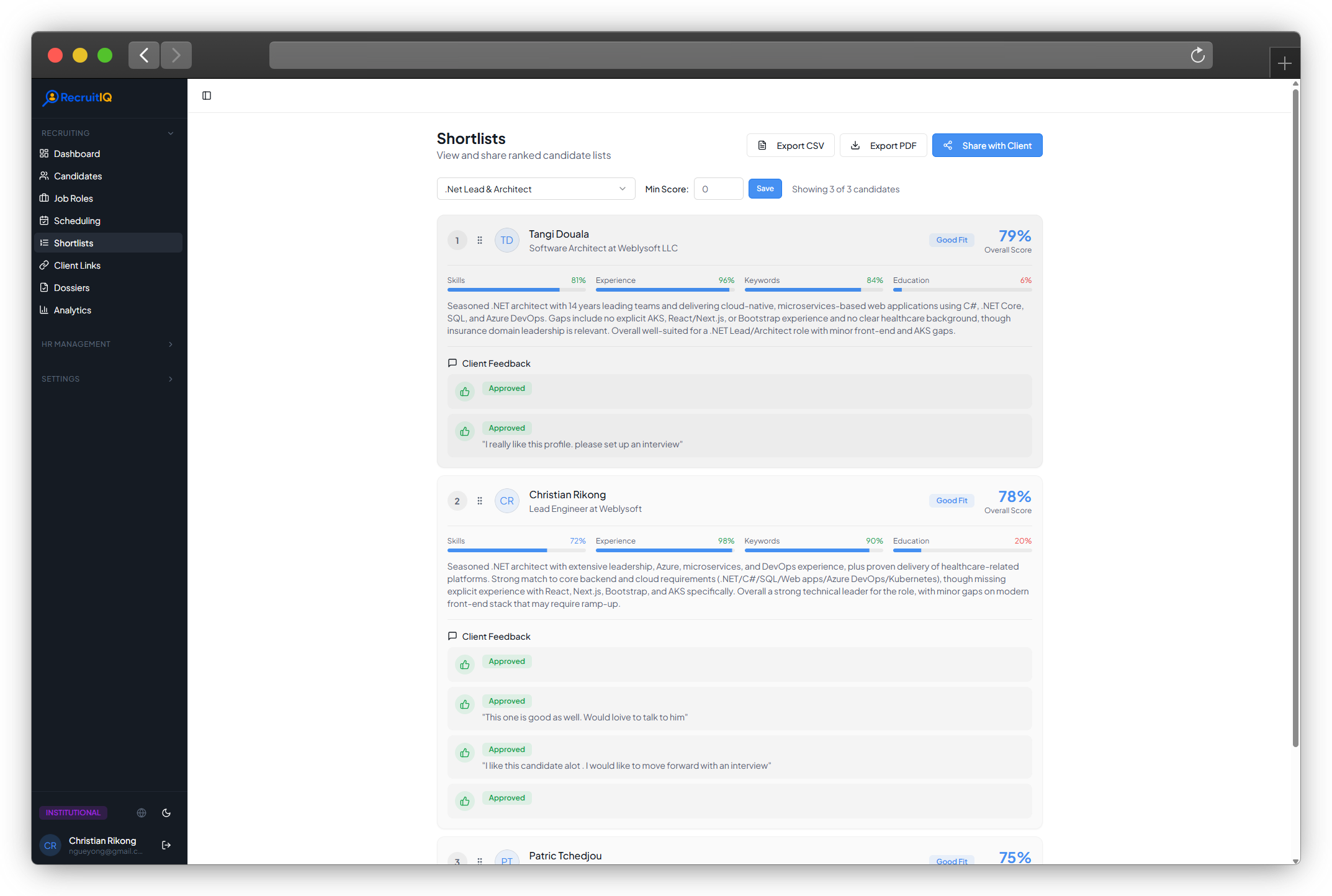
Candidate shortlist; ranked with overall fit scores, skill and experience breakdown, and structured approval feedback from hiring stakeholders.
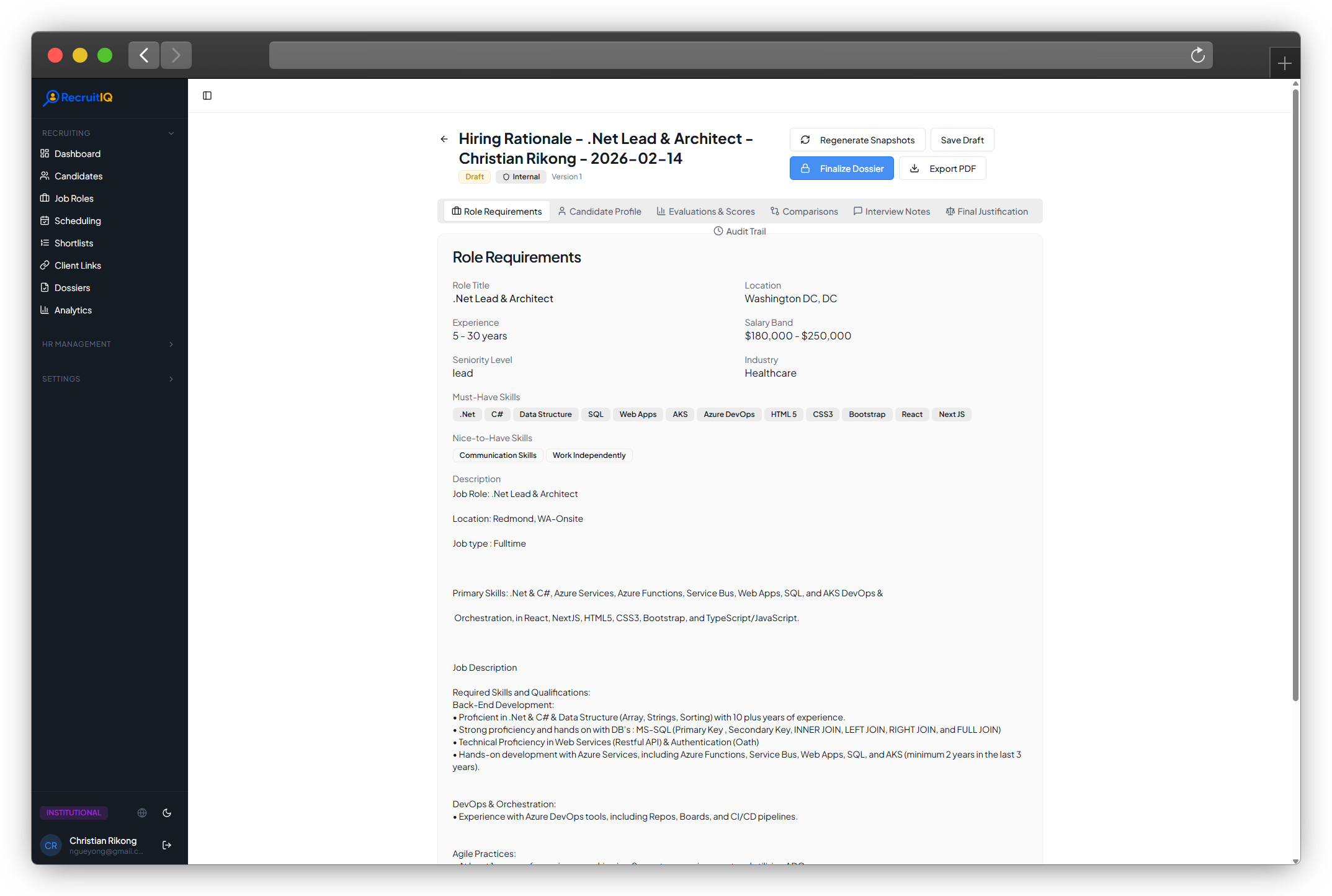
Hiring rationale dossier; role requirements, evaluations, comparisons, interview notes, and final justification captured in a permanent, exportable record.
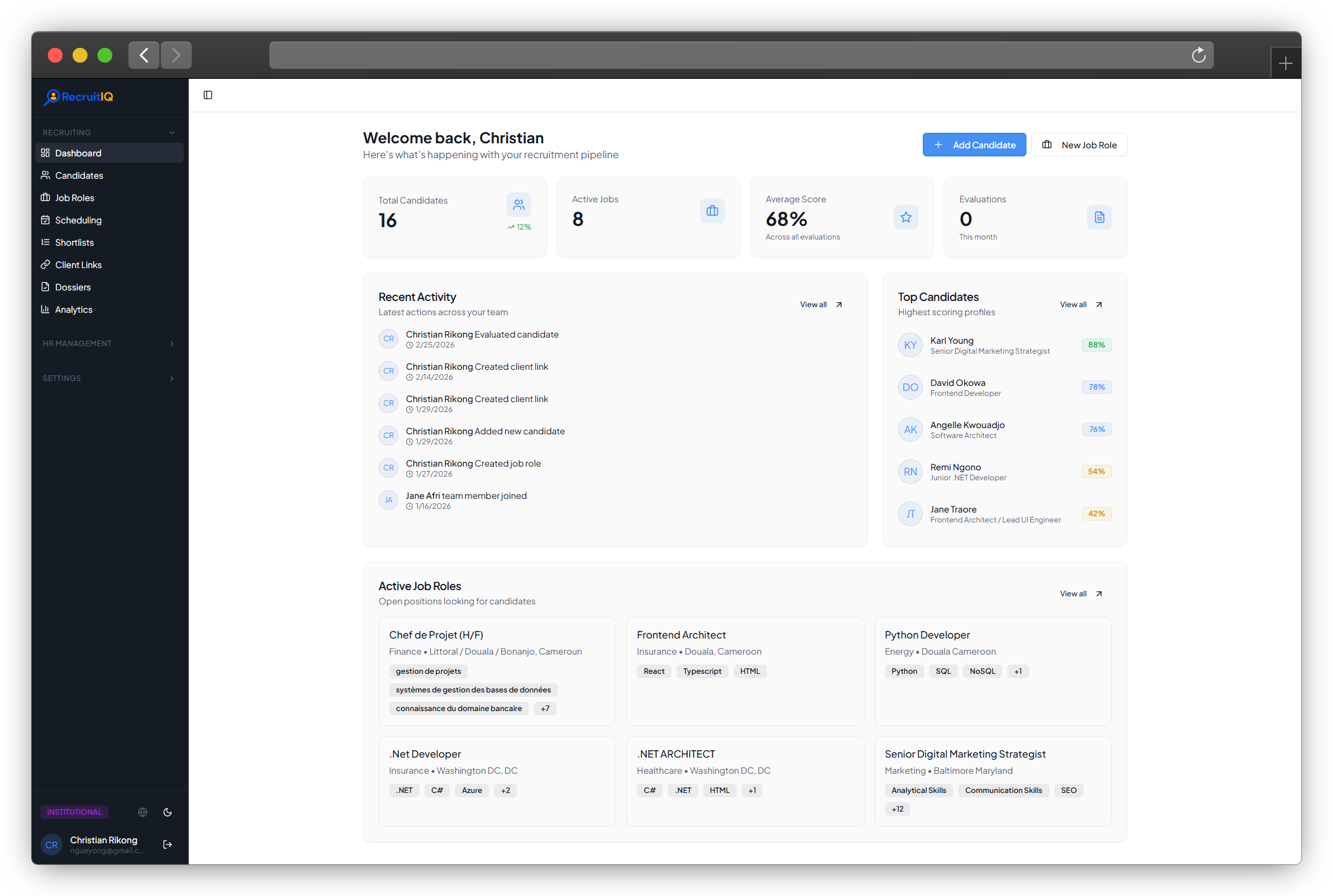
Recruitment intelligence dashboard; full pipeline visibility with candidate scores, active roles, recent activity, and top-performing profiles across all open positions.
These are not hiring notes.
They are decision records.
The structural shift; and what it means for every decision.
- Evaluations are inconsistent across reviewers
- Comparisons are subjective and informal
- Rationale is fragmented across notes and memory
- Decisions are difficult to justify under scrutiny
- Records are incomplete and cannot be retrieved
- Evaluations are structured against defined criteria
- Comparisons are clear and based on consistent data
- Rationale is captured at the point of decision
- Decisions are defensible by default; always
- Records are permanent, structured, and retrievable
This system changes how decisions are made; permanently.
The organization moves from making decisions that feel right to making decisions that can be fully substantiated; at any point in time, under any level of scrutiny.
Leadership gains
- Confidence in every hiring decision
- Clarity in how candidates are evaluated
- Protection against disputes and scrutiny
The organization gains
- Institutional memory across all decisions
- Consistent governance for promotions
- Audit-ready records; always, not on request
A hiring decision intelligence system.
Implemented as part of a broader control architecture; designed to ensure that every hiring and promotion decision is structured, comparable, and fully defensible.
Decisions are one of the highest points of risk in any organization.
When they are not structured, they become difficult to defend; and impossible to consistently justify at scale.
If a hiring or promotion decision were challenged today, could it be clearly explained, consistently justified, and fully reconstructed?
Or would parts of it rely on memory; and someone's recollection of a conversation that happened months ago?
Request a Strategic Review
We assess how hiring and promotion decisions are currently made in your organization, identify where structure is missing, and outline how to make them fully defensible.
Assessment focused on execution, structure, and control. No obligation.